Hand Sewing · Upcycling

Stick or Twist – Laptop Cover Adaption

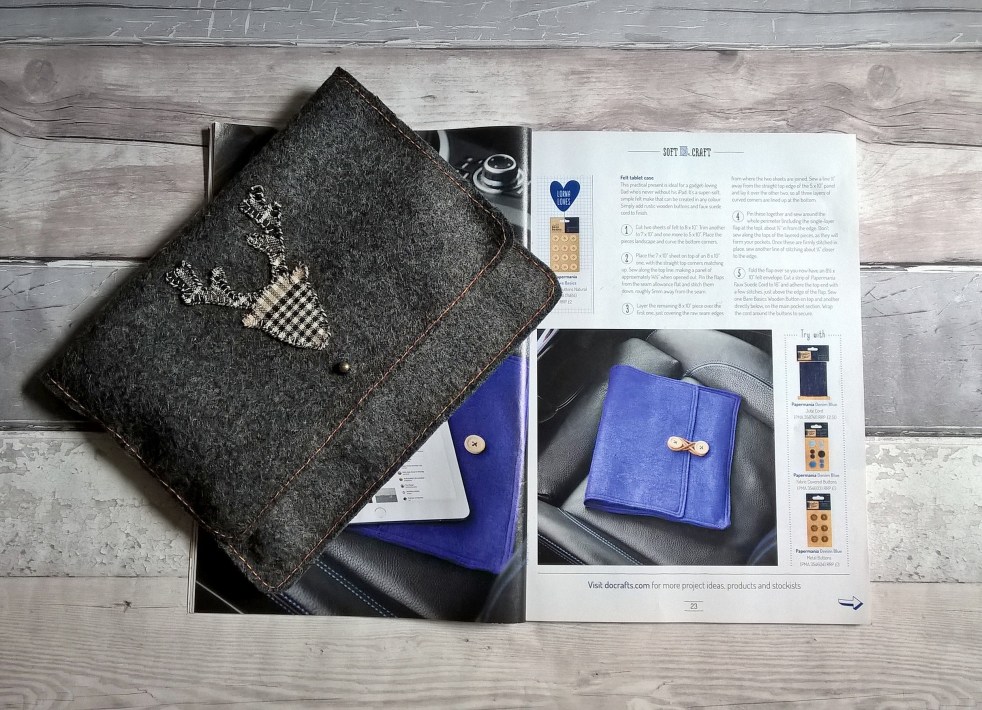
I have been eyeing up this little project in Do Crafts magazine for a few months ( its issue number 70 if you’re interested) and this week I made one for myself.

wp_20161026_12_42_49_pro

I have a few pieces of grey felt from a visit to my local scrapstore in my fabric hoard, so I decided not to stick to the original design and twist it by going for a school satchel look.

The laptop cover in the magazine is machine-made but as I have a penchant for hand sewing mine is all hand stitched.

I wanted to give the dark grey a bit of a lift and I decided to go for my current favourite symbol, the stag silhouette.

I stitched the whole thing together using extra strong thread in bright yellow, using double running stitch ( it looks the same both sides like a machine sewn line of straight stitching), then I used the same thread in a bright red to weave in and out of the yellow for added texture.

The fabric used for the stag silhouette is a scrap of upholstery material, as the fabric frays a bit I used some iron on interfacing to stabilise it. I appliqued the stag onto the cover with blanket stitch and then wove some grey and white twisted wool through the stitches.

The attachment I used to keep the cover closed is usually applied in leather work, it is a called a screwback stud.


Hand Sewing · Upcycling

Circular Motions – Wreath Making

wp_20161014_16_02_24_proAs the seasons turn, I have to admit that my favourite seasons are Autumn and Winter. The colours, the scents, the change in food and I am a big fan of keeping alive family traditions.

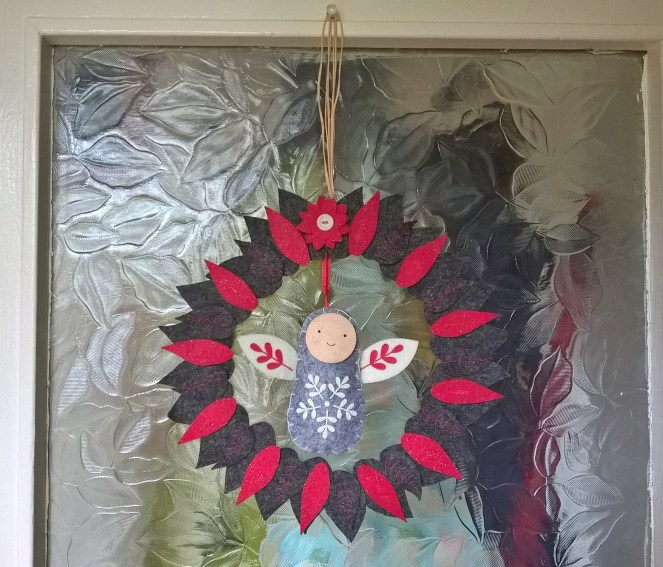
I brought this little Angel quite a while ago and she stays up all year round, in December she is a Christmas decoration and the rest of the time she is a folk decoration!

Last year  I put up a wreath made of dried fruit slices, once the slices had gone past their best I decided to keep the wreath frame to see if I could put it to good use and this is what I came up with……

Materials Required

wp_20161011_17_09_24_pro

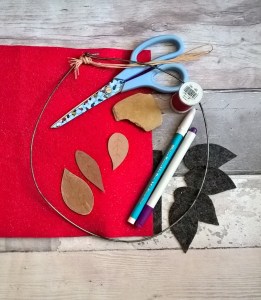
2 Sheets of felt in your main colour

1 Sheet of felt in a contrasting colour

Wreath Frame and hanging loop.

Cardboard Leaf Template in 3 sizes/styles

Fabric Pen/Tailors chalk

Scissors and Pva/Fabric Glue

Needle and Contrasting Thread/Decorative button

I am not too specific with the fabrics and what colours you should use, because I think that hand made items should be unique and this wreath could be Autumnal, Spring like or just matching the decor of your room.

First thing, draw your leaf templates (I used the back of an old cereal packet to make mine) and cut them out.  The largest size leaf to cover the wreath frame measured 6.5cm in length and 3.5cm at the widest part of the curve, the smaller one is 4.5cm by 2.3cm and the long thin ones measured 6cm by 2cm.

Draw round your largest leaf template first, I cut out and used 25 large leaves. Next I cut out the tabs that will hold the leaves onto the wreath, the tabs measure approx 2.5cm in length by 1cm in width. As I used some left over bits of fabric between the leaf cut outs the tabs are not all exactly the same so don’t worry about making sure that they are ruler perfect.

After you have cut all of the large leaves, place the leaves under the wreath frame a few at a time. Place them with a slight overlap and lie them in slightly different ways. Get your glue and put a bit over the middle of the leaf, the same length and width as the tab. As I was using PVA I put some glue on both pieces and waited for it to go slightly tacky before gluing the pieces together. I also put a small dab of glue in between the overlap of the leaves to hold them in place.

wp_20161012_14_06_30_pro

After you have finished gluing all the tabs on the leaves and everything is dry, this is what you will end up with. All the leaves need to overlap and no wire should be seen.

I let this layer of leaves dry overnight with a book on top as I was using PVA glue but it might not be necessary with fabric glue or a tackier glue.


wp_20161012_16_57_09_pro

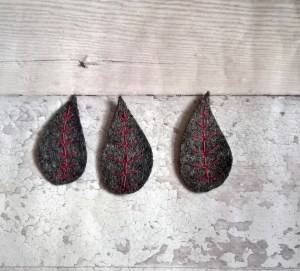
Next cut out your slightly smaller leaves, I used 11 of the small grey leaves. To give the leaves a bit of texture and contrast to the background, I embroidered them with Fern stitch.

The red thread that I used is Guttermans extra strong thread and I started sewing at the tip of the leaf and worked my way towards the base.


wp_20161012_16_49_15_pro


Once the small leaves have been glued on, cut out and layer on your contrasting leaves. I decided at this point that I wanted a flower at the top.

I cut out two six petal flowers and layered them for a Poinsettia effect then stitched the button in the middle. You could use anything to decorate for a bit of sparkle or a different look.

Glue your last pieces on including the decoration and leave to dry before hanging.  Find a place for your wreath and enjoy!

wp_20161014_16_14_16_pro


Hand Sewing · Upcycling · Workshops

Working it out!

After many months of over thinking about how I was going to start sewing classes, what I was going to teach, where I would hold them etc. I have finally taken the plunge and set up a small selection of workshops in the lovely Art Office in Cheltenham.

phototastic-27_09_2016_d9e25b0f-da0d-458e-b09d-ec240a4d6fe51

If you are in Cheltenham  then come and look me up. There are 4 classes, all suitable for adult beginners, each class teaches a couple of stitch types and a short project that the stitches can be applied to.

The classes can be taken separately or as a group of 4. The aim is that I will release a block of classes for people to attend teaching various different ways of hand sewing.

Later I would like to move into applied textile classes such as felting, but still with the stitching element.

phototastic-03_10_2016_172ab086-8303-4440-bd29-15c9c097f3661Lots of people run classes on machine sewing which is great but hand sewing is a fantastic skill to have.

I use hand sewing a lot to take up hems, ( at least an inch off of all trouser as I am on the short side!) fix small areas of mending, also hand gathering as well as decorative purposes.

It’s a great way to relax, portable and keeps your brain ticking over!

You can check out the dates on my home page and click on the link to buy tickets on Eventbrite or contact me via my Facebook page for further details.


Hand Sewing · Refashion · Upcycling

Autumn Influences – DIY Upcycled Wine Bottle Gift Bag

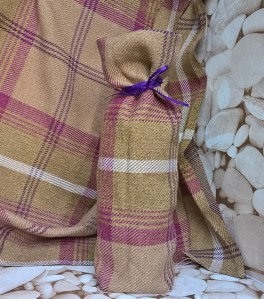
WP_20160830_14_37_27_ProOne of the first jobs I did after becoming self-employed was taking up some curtains for a friend. He had just moved into a cottage with low ceilings and quite a lot had to come off as the hems would’ve been too heavy left uncut.

I was given the left over fabric and have had it for a little while. I decided instead of giving him a birthday present in a normal paper bag I would make him one out of the off cuts and he could either use it again or use it as a decorative cover for a bottle at home. (He loved it & the contents!)

I love the colours, there is something subtly Scottish about it, the purples and greens are shades of the moors. I had some small pieces of chocolate-brown silk lining which I used to give it a great luxury feel!

With September upon us I fancied making another one and pimping it up with a bit of applique and hand embroidery. I have just started using Fern stitch on the swirls and later I will fill in the gaps with various flower designs.


Hand Sewing · Refashion · Upcycling

All made up and ready to go!

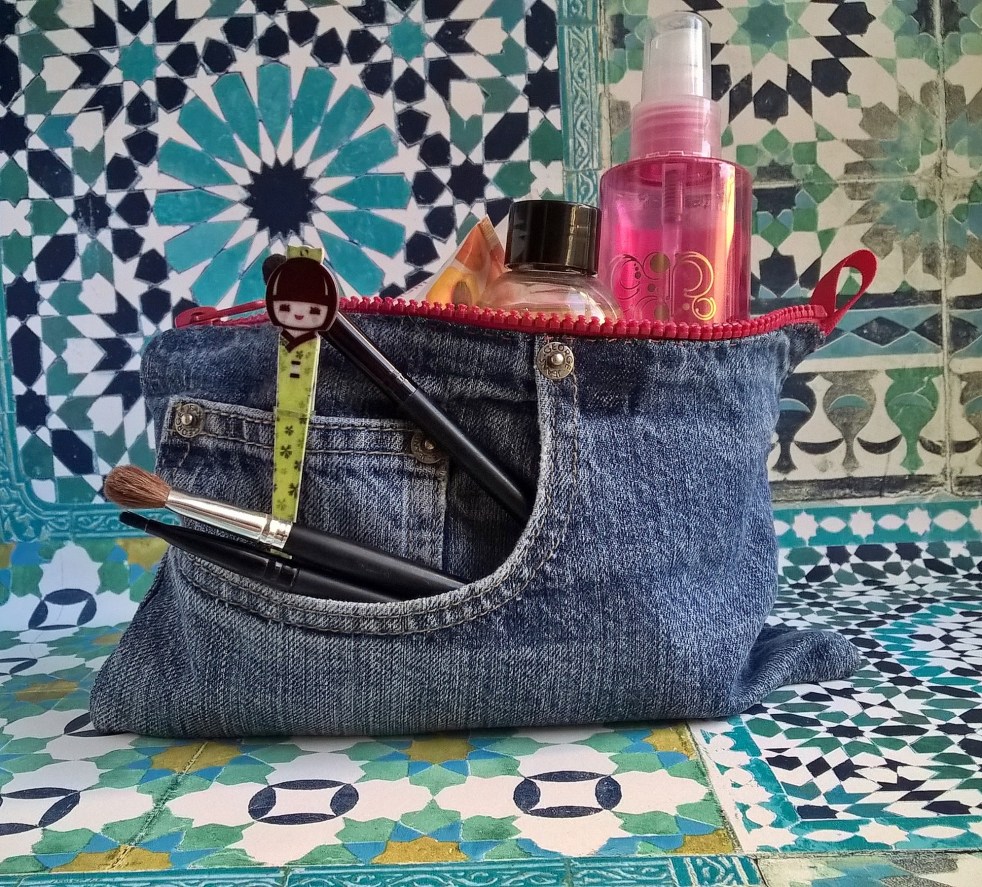
This week I have made myself a new make up bag that I will be taking on a little trip with me in September. Suitably for a re-made item I will be visiting The Festival of Thrift in Yorkshire.

I love the little change pockets in jeans and I wanted to use the pocket in situ, rather then removing it and putting it something else. So, I unpicked the waistband of the jeans in order to use the whole section easily.

WP_20160809_10_53_46_Pro

MATERIALS REQUIRED

An old pair of Jeans

Lining Material to fit

Zip of suitable length

Extra Strong Thread, a Hand Needle

Pins, Scissors, an Unpicker

A Ruler and Fabric Pen

A Chopstick or suitable poker for the corners!

First, I unpicked the waistband off the top of the jeans – keep this it could make a great bag handle, a fabric bracelet etc. Open up the outside leg seam of the jeans, you could open up the inside as well but it depends on what you else you think you will be making as you might want the fabric width.

When cutting out, cut the front pocket side of the jeans as close as possible to the fly opening and measure up and cut yourself a rectangle, think about the width of the bag ( add on seam allowances, I used 1cm and 1.5cm on the zip) and the size of zip you want to use but you can shorten a longer zip if required. I used an 8″ Zip.

Cut a matching size rectangle for the back and 2 more the same out of your lining fabric. It doesn’t matter if you cut through the pocket bag when making your rectangle on the front piece as you will trap the open edge in the seam later on.

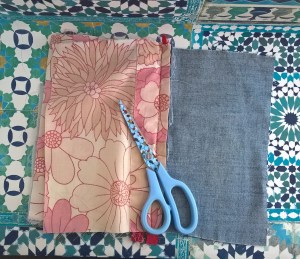
Position the zip between the Denim and lining pieces. Pin one side of the zip in between the topside of the front denim piece (with the pocket) and a piece of the lining with the right sides facing, the right sides should also be covering the zip. Repeat with the other two pieces. You can check that the pieces are correctly pinned before sewing as when you turn them over the zip will be in the middle as seen above.
WP_20160809_10_55_03_Pro

To insert the zip, open out the fabric as seen on the left and stitch along the seam allowance. Make sure that you are not too close to the teeth or the lining will become trapped when you open and close the zip.

Start with the zip closed and as you get closer to the end open the zip so that you can keep the line straight. Repeat on the other side of the zip.

The Zip can be inserted with machine stitching but I  hand stitched the whole thing as essentially I don’t thread up my sewing machine unless I have a good couple of metres of sewing to do or a large project – and I really enjoy hand stitching as I can do it outside in nice weather!
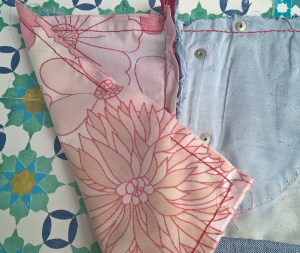
WP_20160810_15_34_29_Pro

Next, open up the bag pieces as shown with the denim on one side and the lining on the other.

Start with the denim piece, lightly pin together ensuring that the bottom edge of the open pocket bag is pinned and will be stitched into the seam if you had cut through it as mentioned earlier. Sew all the way round the denim piece

Next, pin the lining pieces together.This time sew down from the edges and leave a gap in the middle to turn the bag through later on.

As I didn’t overlock my edges I lightly trimmed my seams on both pieces with a pair of pinking shears to stop fraying. Then, I pressed the seams open.
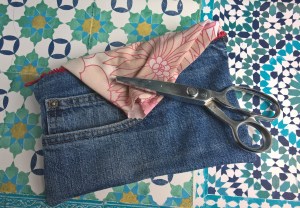
WP_20160810_15_58_26_Pro

After that, turn the bag to the right side through the gap left in the lining. Use your chopstick to carefully poke the corners out.

Fold the raw edges of the lining to the wrong side, so they line up with the seam and stitch the opening shut. I used slip stitch for this.

I hand top stitched the lining and denim together  with running stitch, which traps the seam allowance inside and helps the zip to run smoothly without catching.

WP_20160815_18_49_08_Pro

I used a faded old cotton pillowcase to make my lining from, as the bag is quite small you might see this fabric again in another project!

The Zip I used was quite chunky so I inserted a tab at the point where I stitched the lining and outer sides together. I left a small gap at the end of the zip and poked the tab through so the loop was on the outside and the raw edges were trapped on the inside.

WP_20160815_18_46_37_Pro

READY TO GO!


Hand Sewing · Upcycling

Elysian Fields

Elysian relates to a heaven or paradise, I found these little fields of heaven in my local area next to the Skate Park!

I wanted to take a picture of these fantastic wild poppy areas for sometime but the weather has always been either raining or too windy. I am planning on using the photos  as inspiration for some floral impressionistic embroidery.

I experimented with an old bookmark I had made previously rather then use up some unused fabrics.


WP_20160719_13_46_48_Pro
Trudi Price 2016

I  managed to find some scraps left from old evening dresses that I had made sometime ago,the pink silk has the same vibrancy as the poppies. For the stems I used back stitch but did the back stitch on the wrong side so the stems look more natural and unkempt on the front.

I am pretty pleased with the results so I am going to have a go on some larger pieces of fabric.


All images are subject to copyright, if you wish to reuse an image please contact me first or credit me as part of the useage.

Hand Sewing · Upcycling

New Balls Please!

I had planned to put up a tutorial this week about a fabric cutlery holder I was making but I had one eye on Wimbledon and realised I was half way through before I had taken photos of the method used!

Well, I thought I would do a little post anyway and save the method for another time.

InstagramCapture_a8b0e7a2-f804-4445-9691-1da717930246After I made this bag for myself I had the pieces of fabric left over from the centre of the handles, they weren’t very wide but I like to keep a lot of even fairly small scraps as they can come in handy.

Also, I had been to a restaurant a while a go and kept the little paper holder for the knife and fork, thinking that I might find some use for it.


FB_20160708_17_10_30_Saved_PictureI came up with a little pattern to make my own version and I wanted the edge of the opening to be bound.  Even though I can sew pretty well, I really hate applying Bias binding so I decided to extend the edge of the lining and fold it down I did this first so the edges would be stitched underneath.

Also, I hand appliqued the small circles to the front before stitching all of the pieces together.

I used the bagging out method to stitch the pieces together, by trapping the front pocket pieces between the lining and the outer leaving a small unstitched gap to turn the whole piece through to the right side.

WP_20160706_21_03_20_ProI have made just the one here but if you are going to make e.g a set of two or more then run your sewing like a factory line, cut all the pieces out, stitch all the bindings down, sew the back and front halves together, sew round each holder, turn each one through, then stitch up the gap on each one.


Appropriately, I learned a lot about factory methods when I worked as a pattern cutting assistant for a small factory, which at the time made shorts for the Wimbledon ballboys/girls!

Excuse the different framing on the photos I had been messing around with a bit of editing on a phone app and realised that I had deleted my originals.


Festival Fashion · Hand Sewing · Upcycling

Thrifty Festival Accessories

For several years now festivals have become quite a big pull for people all over the world.  We probably have one of the most famous ones here in England, the Glastonbury Festival.

I went to Phototastic-24_06_2016_7ff305bb-792d-47cf-bcd4-0331b37769daHow The Light Gets In Festival in May, it was rain free! I went to Glastonbury last year for 5 days and got away with one heavy shower of rain! Pretty Lucky huh?

The popularity of festivals has kept an indie bohemian style to the forefront of summer fashion.

As I seem to have a box full of earthy colour scraps and beads, I thought I would put together a few funky tassels and accessories that are festival inspired.

There are loads of tutorials on Pinterest, so instead of putting together a tutorial I have put together a short list of the ones that inspired me.

http://missrenaissance.com/2013/04/01/6697/  – Tassel Inspiration

http://rachaelgreenland.co.uk/felt-balls-tutorial-update/ – A Felt Ball tutorial, its a great tutorial with really loud garden birds in the background!

http://howtodosomething.blogspot.co.uk/2010/01/how-to-make-feather-earrings.html – These earrings inspired the feather necklace pendants.

I like picking up seashells that have become worn and almost skeletal, the shells have natural holes that make threading easy, like the one on the orange thread tassel.

Apart from the roving I bought to try out the felt balls, I didn’t particulary use any specialist tools. The keyring parts are from broken old ones, the beads from old necklaces, I used an awl to make the holes in the leather but they are easily available from DIY stores.

Have a go, if you haven’t got any leather you can get some great effects in other fabrics.

Hand Sewing · Upcycling

Pins and Needles – The Appliqued Needlecase.

Well, its been two months since I last wrote anything on my blog.  I have had a bit of blog apathy as sometimes I feel writing/uploading to a blog can be time consuming and I wanted to try out lots of  different ideas.

Recently, I decided that I needed to make myself a new needlecase. After I uploaded the picture to insta I thought that it might make a good tutorial – so here are the instructions. If you make one let me know and post a picture!

WP_20160615_12_50_53_ProThis is the look that we are going for, a denim cover with a blanket stitched edge and a layered applique front.

I use two different fabrics one Indian style and one is more country style, you will see that I wanted the front to reflect the inside.

Materials Required

Fabric scraps – largest size 14cm x 9cm

Iron on Interfacing

Strong Thread – such as top stitching thread/ Decorative threads.

A size 10 Crewel embroidery needle

Scissors/ Rotary Cutter/Awl/Cutting Mat

Ruler and Vanishing Pen

WP_20160614_12_55_12_Pro

Decide what you are going to use, I like to experiment with my husbands old denim jeans as I love the texture and fade of denim. I used leather on the inside as it doesn’t fray, my local scrapstore has a box full of leather in loads of colours. If you are going to use other fabrics for your inserts then the edges will need to be cut with Pinking Shears so they don’t fray. Any stitches that you don’t know how to do can easily be found by searching the net – I teach myself loads of new things this way!

First measure out your pieces for the cover and lining, I did mine at 14cm x 9cm. If you have a large print on your fabric then see if you can capture a good section before you cut, so you don’t have a lining with a random half flower on the inside!

WP_20160614_13_57_01_Pro

Cut out your interfacing so that it is the same size as the cover pieces. I have put the interfacing on both pieces of fabric as they are prone to fraying. Remember to iron them on the wrong side of the fabric!

Next, cut out the shapes you want to use on the front of your cover, you can stitch them on now and then cover the stitches with the lining. I did mine later on as I just caught the stitches through the denim. After that, pin the lining to the cover, wrong sides together and Blanket Stitch all the way round the edge.

Try and get your inserts to have a nice colour blend with your lining, or if you have bright colours go for a clash! Cut the inserts 2cm smaller all the way round. So, the largest one is 12cm x 7cm and the smallest one is 10cm x 5cm.

I punched the holes 0.5cm apart with the Awl on a cutting mat (mine is really old, you can use soft wood such as cork for a surface). Make sure the holes line up on both pieces of leather. Use your vanishing pen to make a mark on the fabric where the centre of the case is, make an anchoring stitch that will be hidden under the edge of the large piece of leather and start sewing the leather pieces to the outer case. Use Double running stitch and the Crewel Needle.

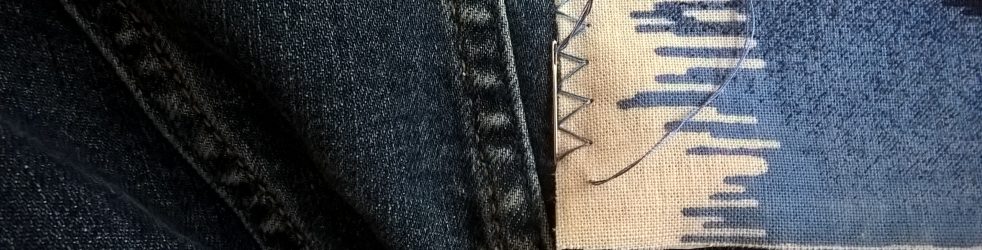
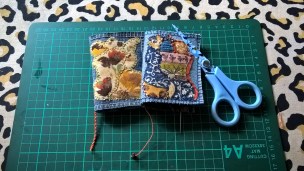
As you can see, I layered on my applique pieces after I blanket stitched the edge. This is so I knew it would fit into the space.  I attached the applique with a hand sewn Zig -Zag style stitch as the edge is quite fragile. In the photo on the right you can see the double running stitch down the spine of the needlecase.

I decided to attach a tail to the needlecase, I used a bit of retro crochet yarn I bought in a charity shop. I wove the yarn through the straight stitch down both sides, leaving a long end which I twisted up and anchored so the twist won’t undo itself. You can see in the photo below I used a single piece of yarn and finished it with a  bead at the bottom.

WP_20160615_12_50_53_Pro

That’s it!


Save

Save

Refashion

Keeping a Check on Fashion

Keeping in with the upcycling theme of my blog, this month I am sharing a little refashion project I did on a sleeveless wrap jacket.

InstagramCapture_bd3bd1fc-0b49-4a87-a242-a63bc8ab25b4I brought this unlined wrap jacket in the early Autumn, I only wore it twice. This is for a couple of reasons one is it has been a really wet winter and the second is it is quite a thin fabric and was getting pretty creased if I wore it sitting in the car.

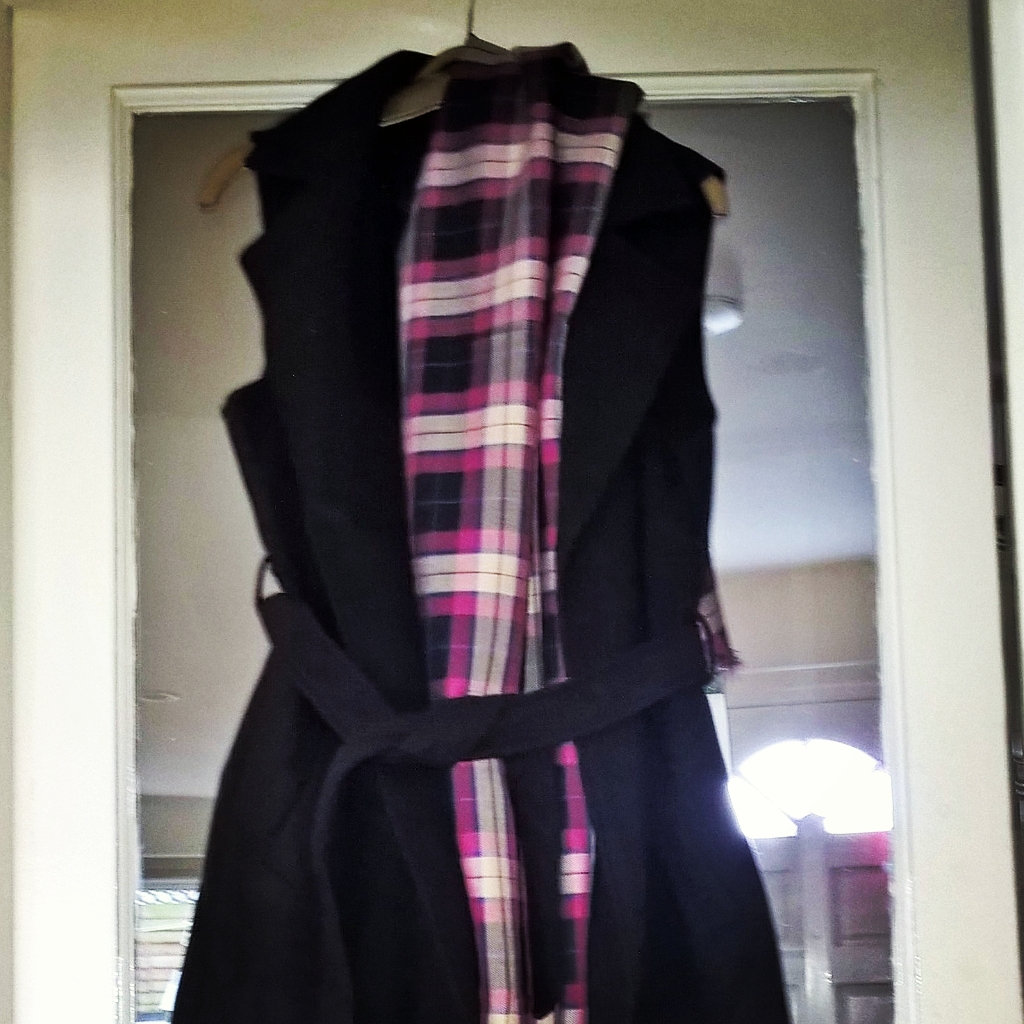
I decided to line the jacket, to give it a bit of reinforcement which would help it to stop creasing if I sat down in it and I love a funky lining. A great lining is like nice underwear, no one can see it but it makes you feel good.  I didn’t choose a typical lining as it would’ve been too thin, the check is a thin woven wool mix, I purposely chose this to add body to the piece.

The inside of the jacket was fully faced ( in the picture where I am holding the jacket open you will see the black inside where the facing meets the checked lining). I started by measuring the back, then measured for the front side from the side seam to the facing edge and added seam allowance to the pieces.

WP_20160317_16_03_49_ProThese are the finished pieces, when I pinned the pieces to the fabric I made sure that I was following the grain of the fabric. This was easy as the fabric is checked to I had to make sure that straight lines running up the paper were lined up with the straight lines on the check. I could pin the pieces opposite ways up as the check is regular, if you have a one way print, e.g you have flowers that only run up the fabric then you will need to make sure that all of your pieces face in the same direction – which also takes up more fabric.

Here is the finished jacket.  I was really pleased with the end result and after wearing in the car, when I got out it hardly creased at all. Excuse the dodgy modelling, it’s not really my thing! I had some left over fabric so I think I will make a scarf to go over the top, if people catch sight of the lining and the scarf when I go out somewhere, they might think I had a matching set custom-made for me!

Phototastic-25_03_2016_37bf3dfc-4b18-42ee-bc0f-f4136e62e178

Here’s to spring and dry weather!